Monday, October 31, 2011

My Insurances

This, possibly above my hating of credit column, may face the most opposition within our culture. Admittedly, even I groan at using a sinking fund to pay for those expected cute little things called annual and monthly premiums. At the very core of it drives the main question: What is insurance? To me insurance provides peace of mind against inevitability at a cost. I will get sick, (odds and percentages are in my favor that) I will take a medical leave of absence from work within any given 10 year span, Home repairs will be needed and I will die, these are the inevitabilities people! The wildcards are for how long, to what extent and when.

First and foremost my general approach to insurance fundamentally requires a six month liquid emergency fund to be intact. Though informal, I consider the emergency fund in itself to be insurance. Rather than being invested in a mutual fund, the emergency fund earns close to nothing in interest in today’s environment and, like insurance coverage – having the emergency fund costs me. The importance of the padding that the emergency fund provides is that it allows you to raise deductible amounts and lower premiums. I cannot stress enough that the emergency fund is crucial to having higher deductible amounts on insurance plans. With a higher deductible you will have to pay more out of pocket for incurred expenses, which can be easily found in your (duhn duhn duhn!!) emergency fund. Now, onto the types I currently carry:

·         Medical
·         Long Term Disability
·         Term Life
·         Renter’s
·         Dental

The last piece that I will elaborate on is Term Insurance. I currently carry a 30 year level term policy and the face value is around 10X my annual income. I do not combine this insurance vehicle with savings, which is what whole life insurance products promote. I despise these guys and anyone selling/pushing/salivating at the idea of you buying whole life insurance, and here’s why.

The concept behind whole/variable life insurance policies is that you build savings in addition to paying monthly premiums. What they won’t tell you and what you have to read for yourself in their policy, is that WHEN you die your beneficiary (family..right!!) will receive only the face value of the insurance policy and the savings that you will have built up becomes property of the insurance company and they pocket it for themselves. If that were not reason enough, these clowns can run circles around and dizzy you with their fee structures “as you are building your (their) savings account.”

The alternative that I have chosen is to have a term life insurance policy whose premium for me comes out to just under $30 a month. I then invest/save for myself without paying stupid fees. This is done so that when I die the savings accumulated will go to who I want it to go to, and I mean it when I say insurance companies that push whole/variable life will never be listed as my beneficiary. Of course what happens when my term life policy end date comes? Well, let’s say (and I’m being very modest here) that I stock away $100 a month in a good growth mutual fund for 30 years/the length of my term life policy that averages 12% growth annually. At the end of my policy, that $100 a month put away for 30 years will worth $352,991.10 and NONE of that will go to an insurance company more interested in fees than my financial peace.

Friday, October 28, 2011

My Beef with Professional Sports

For anyone that knew me growing up, they would be shocked at me for making the following statement: I do not follow professional sports in any way shape or form. Perhaps my frugal ways have shone a gigantic spotlight on what is my fundamental beef with professional sports. Let’s say for example that I wanted to take my wife to a Chicago Bears game in a couple weeks to see the San Diego Chargers, a team I was a fan of growing up in Los Angeles. The cheapest tickets currently available via Ticketmaster at face value would cost us $161.08 just to get into the stadium. From there you can make your own deductions about food prices, souvenirs and the like. But $161.08 just to get into the stadium, and this is at the cheap end! Seating capacity at Soldier Field is 100,000 people. So being EXTREMELY conservative at $80.54 a person, filling a stadium for each game brings in ticket revenue of $8,054,000 per game, 8 times over and you generate $64,432,000 just in ticket sales.

Now I’ll bang on this drum again, I am not against people or companies making money. But the cost of nearly $200 just to get my foot in the door can go so much further than a three hour game. Invested in a good mutual fund averaging 12% annually, in 30 years that $161.08 WITHOUT ADDING ANOTHER PENNY TO IT would be worth $5,793.45… so I hope you enjoyed your game!

If I couldn’t be irked any further, is the idea that players’ unions exist. Now as a (partial) objectivist, while I vehemently take a firm stance against unions and see them as an obstacle to running successful businesses, I understand their goals and concerns, I just think they go about it in an entirely wrong and inefficient manner. To me unions were created with the intention to provide safe and humane working conditions for low income employees. Not to redistribute wealth. Now my cynical self would come back to say that if employees were not treated well or in unsafe working conditions or feel that they are not getting paid their worth, then hit the employer where they hurt and quit. Deliver pizzas, wash dishes in a restaurant, sort merchandise for a big box retailer, essentially: think for yourself and pursue a field/industry/job and fight, scratch and claw so that you happen to success. Without valued able bodied employees the employer will crash and burn. It is in a companies’ best interest to treat their employees as they do their clients: with respect.

Where is this all going? To the fact that even with the best of intentions, I do not feel that unions were created for people that are required to have a six figure minimum income. According to nba.com the most recent minimum salary is the nba was at $473,604 for rookies and $1,352,181 for a veteran. The average player salary, only a modest $5.15 million annually. Which brings me to the current nba lockout. Players feel that the owners are being unfair in redistributing wealth. I find this to be ludicrous and absolutely outrageous. With 29 nba teams, (12 players to a team) 348 players, players earning an average of $5.15 million a season, this means that annually nba players as a whole generate an average annual income collectively of $1,792,200,000

If these wasteful jerks would efficiently combine their resources and efforts, and truly felt that nba owners were stealing money from them, $1 billion dollars should be more than enough as a starting point to start your own league where you can play by your own rules. Professional athletes are blessed to have a large income shovel for a short period of time in their lives. Yes, it is a hard and tough uphill climb for Wal-Mart employees to band together and open a competing store. But professional athletes have absolutely no excuse. More is provided to them and if they would think for themselves and work for their own self interest they could put together a quality product at a reasonable price. And that is my beef with professional sports.

Thursday, October 27, 2011

My Dream Home

This is a posting that I have been looking forward to composing and have a smile on my face as I type this. My dream house. Perhaps there is a heightened sense of anticipated accomplishment with this item because it is a goal on my list. It could also be because the way in which I plan to achieve this goal is beyond convention in our current environment in which revolving credit is the norm. I plan to pay, in cash, for my first home. No mortgage, free and clear. I spurn credit and everything about it. So for what should be the largest expense in my adult life, credit is not an option for my wife and I. We actually began saving for this goal during the market downturn in 2008, and, depending on whose projections you read (my wife’s or mine) we will have reached this savings goal, either in the summer or end of 2012 (HINT: I’m always conservative in my estimates).
            To qualify all of this, let me give you some background. We currently live in Chicago, Illinois. We live in a northside neighborhood that breeds hyperconsumption. Everywhere around us there are rows of bars, clothing boutique stores, overpriced condominiums, high taxes no matter the type of expense, women clad during the summer in maxi-dresses and men who love them for it (i.e. slaves to trends). At best, a modest 1BR condo in our neighborhood, even in the real estate downturn, would easily sell for a modest $200,000
I have no interest whatsoever in owning real estate in this great city. Chicago is a great city, and what makes it great is its neighborhoods. Each one has its own identity and as a collection, make Chicago a great town. For me this has been a fun and great place to spend my 20s post college. But when I think about where I want to lay roots down, raise a family, pay taxes, and the type of people that I’d like to have as neighbors until my children make it to collegiate ages, Chicago is just about on the bottom of my list (Los Angeles is lower). Yes it is fun to take a stroll with my wife around the neighborhood at any time on any given weekend, and make funny observations and create inside jokes of the drunken hyperconsumers decked out in their ugg boots and plaid shirts, as they embrace their Sunday brunch loving ways. But to be in my 30’s, pushing a stroller through Wrigleyville, and having to answer questions such as: Why is that lady orange? Why are sick people stumbling out of that restaurant? Why are so many people smoking outside of those buildings? Why is everyone playing on their phone? Answering these questions is not exactly how I envision parenthood to be. I want my children to grow up with a sense of peace and security in their world, not just inside of their home but outside of it. Sure, the world can be a bad place with people that will take advantage of you. But, as an adult, I am learning that people, for the most part, are inherently good people and are worthy of my trust and love without conditions. It is in my personal boundaries, where I can deepen and develop relationships. And as an adult I have come to believe that people, left to think and rationalize for themselves, are inherently good. Basically, I want my family (and myself for that matter) to establish our own individual boundaries of what is acceptable and unacceptable in our lives, knowing that people are good, all without the skewed perceptions of growing up around drunken hyperconsumers. So where’s a guy to go?
            As if taking a page right out of, “The Millionaire Next Door,” my wife and I have a short list of areas in lower to middle class neighborhoods, where we will research and visit, to raise our family. This short list includes: Charlotte, NC, Nashville, TN  and Raleigh, NC. On a logistical level these areas are a dream. There are multiple BR homes in each of these housing markets, with at least triple the square footage of anything listed in Chicago, for a fraction of the cost. We plan to pay cash for a home in one of these areas and do not plan to spend more than $80,000 doing it. Through this we set ourselves up to never have a rent or mortgage payment, EVER! Plus, since we currently live on roughly $20,000 a year, there is no pressure to find jobs that are equal or greater to our current salaries. In fact, if one of us wanted to be a stay at home parent, we could with no regrets or financial strain on our lives.
            For me these areas represent the lifestyle that I am choosing to lead, and one that I want to impart onto my children. Frugal living, knowing the value of a dollar, living below your means, and good old fashioned community where you actually know your neighbors on a first name basis, these are the things that I want in the next chapter of my life. Chicago has been great to me and I have a flood of great memories from the street fests, winters and my career, all thanks to this town. And while I still have plenty more to make, having the next step in mind helps me stay focused on what I want to achieve in life and where I want to be in the future.

Tuesday, October 25, 2011

My October Grocery Challenge Weeks 3 & 4


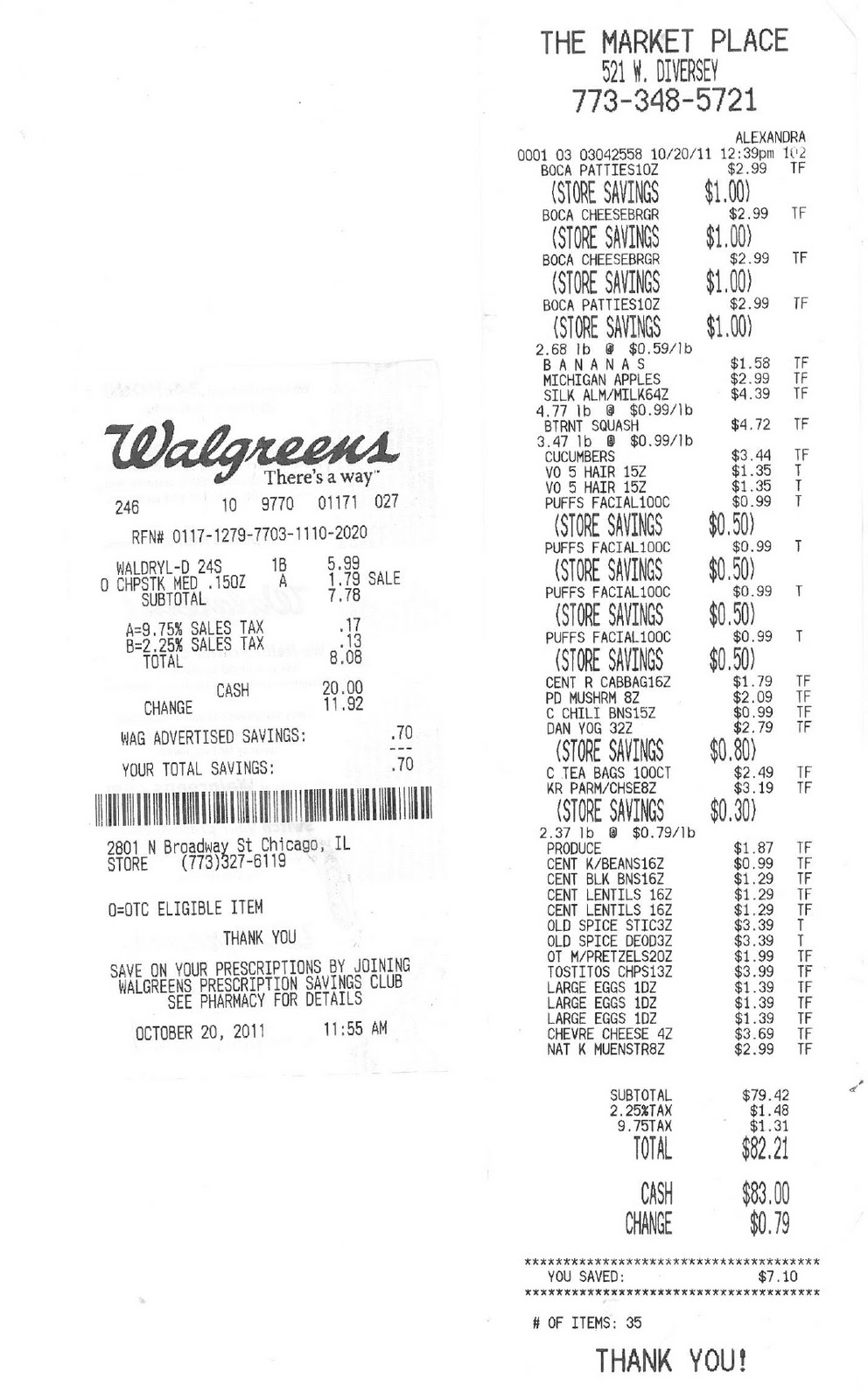
Alas I have succumbed to the rise and fall of recent weather conditions here in the Mid-West and find myself sick. Would it lead to being a budget buster during my October grocery challenge? Thankfully, no, it (so far) has not. Though weak and unable to make the voyage that includes a bus ride and dragging a rolley-cart to my favorite place in the world (Aldi), my wife and I shopped at our local grocer and Walgreen’s. For Week 3 we hunkered down and used our cabinet supply of inventory that we had on stock and got out to shop for week 4. Highlights of this trip: Vegetarian burgers on sale, apples/squash and cucumbers each for under $1 a pound. My relentless coughing and sneezing (yuck, I know) lead to a need for more facial tissues, which, thankfully were on sale. My personal favorite though, a 100 count of tea bags for $2.49. That’s 2 cents for a teabag, which in perspective, makes me question my local (albeit great) tea lounge and their rates for a single cup of tea for about the same price that I paid for a 100 count.
            Our total spending for the week came out to $90.29, a current month total cost of $167.24, leaving our October grocery budget with a remaining $172.76. So with one week to go in the typically tough 5 weekend month, we are on pace to hit my dream goal of being near $200 total spent for my wife and I. Will we make it? Will my craving for vegetarian burgers bust the budget? Will I regain the strength to make it to Aldi for week 5? Stay tuned…

Friday, October 14, 2011

Thursday, October 13, 2011

Book Review: "The Total Money Makeover" By: Dave Ramsey

            It is a distinct honor and privilege to provide my book review today. For me, this is the book that changed everything in my life. This gave me the power to stand on my own two feet, live as a responsible adult, and change my life for the better. The information in this book literally transformed my life and it will do no less for you. Dave Ramsey’s “The Total Money Makeover” is the one book that we all should have read and studied during school before we were unleashed into the real world. But thankfully, even for those of us that are already adults and have experienced stupid with 0’s on the end, this book gives the written game plan on how to turn your financial life around for the positive.
            Dave does an absolutely outstanding job in transitioning from real world true life examples, to the x’s and o’s, to dispelling popular money myths. My favorite money myth that gets shattered is the tax advantage of paying interest on your mortgage vs. living debt free. The myth is that it is a good decision to keep your mortgage for the tax deduction. The truth, we are paying $10,000 in interest annually to our lender rather than paying $3,000 to the government and keeping $7,000 for ourselves. The book is filled with gems like this one that will turn your views on credit completely upside down and rock your world.           
            Now I have probably read this book close to 50 times over the last two and a half years, but every time it puts a smile on my face and reassures me of the path that I am heading down and choosing for myself. Of course the memories of reading it for the first time are still very vivid in my mind. About ¾ of the book beginning from the front cover, challenged me and presented such a plethora of information that conflicted with how I thought smart personal finance worked that I had to re-read a lot of sections over and over again. The information is presented clearly and concisely, I just needed to get my brain on the same wavelength. The layout of the book, that ¼ of it covers the baby steps, really drives home the point that smart personal financial decisions are 80% behavior and 20% head knowledge. The KISS method also fits the bill (keep it simple…STUPID!!). So to the financial goobers who bemoan that Dave’s method is way too simple I’ll say this: I got out of debt, live on a budget and keep my investing style extremely simple and I LOVE IT! To everyone else, if you read one book in 20 years, let this be the one, it will rock your world!

Wednesday, October 12, 2011

My October Grocery Challenge: Week 2

            Grocery shopping has never been more fun…SERIOUSLY! For week 2 of my October grocery challenge, I happily made it to the mother of all frugal shopping locations, ALDI. I love Aldi. I love everything that it is and stands for. Yes, there is a true stigma with this grocer within social communities. To the hyperconsumer it is perceived as cheap, low quality and found in the bad end of town. So naturally, if the norm is to avoid Aldi, I’ll run to it as fast as I can. I have been shopping here for a few years now, and I am sorry for not patronizing this fine grocer sooner. Aldi represents a lot of what I am all about: everyday low prices (no sales needed), not being a brand snob, quality based on content and not the name, and did I mention that they do not accept credit cards?? Cash and debit cards only. Aldi encourages (ok, forces) you to avoid going into debt, how can you not get behind that!
            Back on track though, this week our household opted to stock up on items for our ongoing and future needs for meal planning. Highlights of this week’s trip included continuing to grab fruits for under $1 a pound, and this week we scored Michigan apples, bananas and avocados. In addition, my home church also sponsors a weekly meal for the area’s homeless community, and regularly accept specific donations. So for this week we picked up extra bottles of ranch dressing for the program’s needs. With everything said and done for week 2 our total came out to $54.87 for 45 items. So after 2 weeks we have spent a total of $76.95, leaving a remaining budget balance of $263.05 with 3 weeks to go.